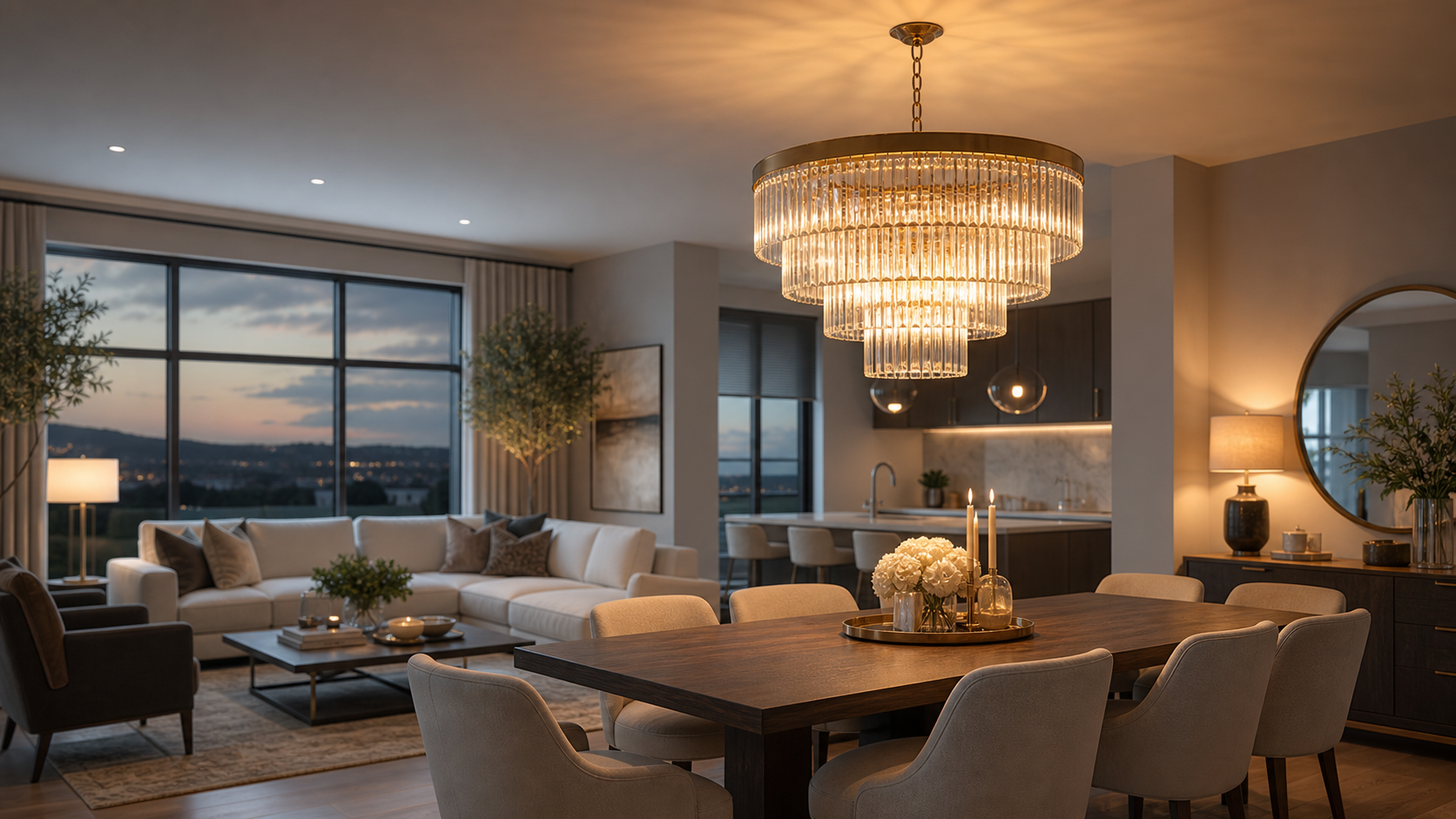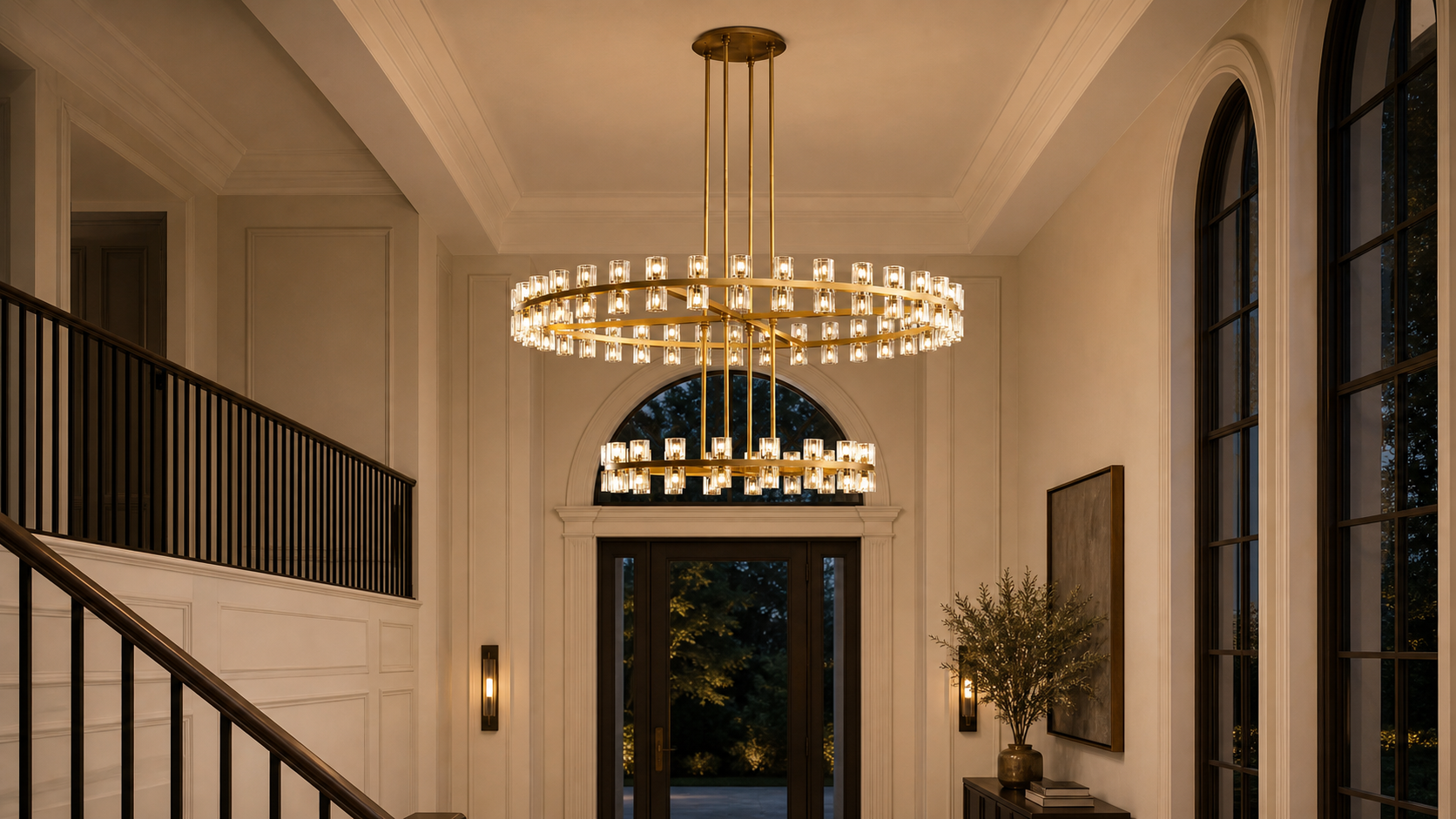

Quick answer: Most kitchen islands use two or three pendant lights. Choose the number by measuring the usable island length, the pendant diameter and the spacing between fixtures. Two larger pendants often look better than three undersized ones, while three compact pendants can spread light more evenly across a long island.
Do not start with the number of ceiling junction boxes. Start with the actual fixture dimensions and the countertop area that needs light.
Use this pendant spacing formula
Keep the outside edge of each pendant approximately 6 to 12 inches inside the ends of the island. For most medium fixtures, allow around 24 to 30 inches from the center of one pendant to the center of the next.
A practical planning formula is:
Usable island length = island length minus the two end clearances.
Fit the pendant diameters and the spaces between them within that usable length. Always use the widest point of the shade, not the canopy width.
How many pendants for common island lengths?
| Island length | Useful starting arrangement |
|---|---|
| 4 to 5 feet | One large pendant or two small pendants |
| 6 feet | Two medium pendants |
| 7 to 8 feet | Two large pendants or three compact pendants |
| 9 to 10 feet | Three medium pendants or one long linear chandelier |
| More than 10 feet | Three large pendants, four compact pendants or a substantial linear fixture |
These are visual starting points, not electrical rules. A wide glass dome needs more breathing room than a narrow cylinder, even if both products are described as pendant lights.
Two pendants or three?
Choose two pendants when the shades are visually substantial, the island is around 6 to 8 feet long, or you want a calmer and less repetitive composition. Two fixtures also leave more open sightlines in a kitchen with decorative cabinetry or a statement range hood.
Choose three pendants when the island is long, the shades are compact, or even pools of task light matter more than a minimal look. Three fixtures can also help an island feel centered when it has three or four seating positions.
How wide should each pendant be?
Many residential islands work well with pendants approximately 12 to 20 inches in diameter. A small kitchen may need narrower shades, while a broad island in an open-plan room can support fixtures 20 inches wide or larger.
The Botanist Dome Pendant uses a clear glass shade, so it appears lighter in the room than an opaque metal fixture with the same diameter. This makes it useful when you want visible scale without blocking the view across the kitchen.
How high should the pendants hang?
In most kitchens, position the bottom of the shade 30 to 36 inches above the countertop. With a 9- or 10-foot ceiling, the fixtures may hang slightly higher, but countertop clearance and sightlines matter more than the distance from the ceiling.
Raise the pendants if they block faces, the range hood or an important view. Lower them slightly if they appear disconnected from the island or do not provide useful light on the work surface.
Center the group, not each stool
Center the complete pendant arrangement over the island. Do not automatically position one light over each stool; seating can move, and stool spacing may not match the fixture dimensions. Treat the pendants as one balanced composition.
If the sink or cooktop is off-center, a small intentional offset may make sense. Check the arrangement from the main kitchen entrance before moving electrical boxes.
Clear glass versus opaque shades
Clear glass pendants keep a kitchen feeling open and allow light to spread broadly. They also expose the bulb, so bulb shape, color temperature and brightness become part of the design. Use dimmable bulbs when possible and avoid glare at seated eye level.
Opaque shades direct more light downward and can reduce glare, but several large opaque fixtures may visually divide an open room. Choose based on both task-light needs and the view through the kitchen.
Test the layout before installation
Mark each proposed pendant center on the ceiling with painter's tape. Hang lightweight paper circles or balloons at the planned shade width and height. Then inspect the mock-up from seated and standing positions.
This simple test helps answer:
- Are the pendants too close to the island ends?
- Do they block conversation?
- Is the space between fixtures consistent?
- Does the arrangement align with the island rather than nearby cabinets?
- Will cabinet doors or the range hood interfere visually?
Kitchen island pendant checklist
- Measure the full island length and width.
- Confirm the pendant's widest diameter.
- Leave 6 to 12 inches inside each island end.
- Start with 24 to 30 inches center-to-center spacing.
- Hang shades approximately 30 to 36 inches above the counter.
- Check seated and standing sightlines.
- Confirm bulb, dimmer and adjustable-drop compatibility.
Frequently asked questions
Can I put three pendants over a 6-foot island?
You can if the pendants are compact, but two medium fixtures usually create a less crowded arrangement. Calculate the actual shade widths and spaces before ordering.
Do pendant lights have to be evenly spaced?
Yes, equal spacing usually looks most intentional. The outer clearances can differ slightly when a sink or cooktop requires it, but obvious uneven spacing should have a functional reason.
Can I use one light over a kitchen island?
Yes. One oversized pendant or a linear chandelier can work well, especially over a compact island or when you want one centered focal point.
Compare more shapes and sizes in the pendant lighting collection and review the listed dimensions before choosing a final layout.